
Yvan Cohen
Wed Apr 08 2026
Will AI Make DAM Software Obsolete?
 Will AI Make DAM Software Obsolete? Generated Image
Artificial Intelligence (AI) promises to be one of the most significant technological leaps mankind has ever seen. I say "promise", but in truth AI might equally be one of the most significant technological threats to mankind too.
Let's be clear, AI is different from any other technology humans have yet developed.
The coming generation of AI will think. It will solve problems independently. It will have a mind (or minds?) of its own. An all-knowing, perhaps all-seeing (given how many cameras watch over us), presence. A brain that never tires, that never forgets and that can never be switched off - unless one was to "unplug" the planet.
It's thrilling, exhilarating, fascinating, supremely useful and very, very scary.
We are entering an era where humans risk being surpassed by machine intelligence of our own creation. An intelligence that cannot feel compassion or empathy and has no consciousness. At least not in the way humans do, and not as far as we know (although some scientists are already wondering if artificial intelligence might have already developed a form of consciousness).
For the moment, it's fun and useful. I can describe an image and AI will create a visual interpretation of my words in seconds. I can ask AI to write letters, to produce analytical reports, do research, write summaries, and even give me relationship advice. But what does this mean for software... and for digital asset management (DAM), in particular?
When Knowledge Loses Its Currency
If AI becomes a universal reference and source of knowledge, there is little doubt it will upend our societies, which have hitherto yielded power and status to those with knowledge. "Knowledge is power", goes the saying. Those with education and knowledge - doctors, lawyers, journalists and, yes, code writers - sit at the pinnacle of our social systems.
If their role is supplanted by AI, what will that mean for future generations of doctors, lawyers and developers? Of what value is a lawyer if AI already knows every statute and every precedent ever recorded and can provide you with an opinion based on that data in seconds? Why would we pay lawyers for information that can be accessed via AI with such ease?
Doctors too. How will they be able to compete with an AI diagnosis based on all existing and known relevant cases and data on the planet? No human could retain and instantly process such a vast reservoir of knowledge. It might be nicer dealing with a human doctor, but will it be as reliable and efficient?
 Designing Ourselves Out of the Picture. Generated Image
Designing Ourselves Out of the Picture
The concern is that in a twist of supreme, and frankly tragic, irony we may have created such powerful technology, so perfectly calibrated to making our lives easier, that we are effectively designing ourselves into a form of obsolescence, or irrelevance.
In practical terms this could mean a transformation and hollowing out of labour markets. Read: rising unemployment.
Already fresh graduates are finding it harder to find the starter jobs that require their basic knowledge and skills - performing the kinds of relatively simple analyses that AI already does so well.
In the world of software, the dual-edged promise/threat of AI looms particularly large. For if there is one thing AI knows better than anything, it is computer code. After all, AI is computer code. Its very essence and substance, if substance it can be called, is code.
A Blessing, For Now
In these heady early days, AI often feels like a blessing. For small companies like LightRocket, AI is enabling us to hugely accelerate the code-writing process. Our developers tell me that in some cases we're able to solve problems and create new features up to 10 times faster with AI. It's proving to be a boon, allowing us to evolve and innovate even more quickly than usual.
It feels like a leveler that will allow us to compete more directly with larger, better funded, competitors. In many instances our developers, as skilled as they are, no longer need to write code. Instead, they write prompts so that AI agents (as they're called) can write code for them.
The logical conclusion of this process is that AI will eventually write all code, which means eventually we'll no longer need human developers.
This might sound extreme but given where we are now, and how quickly we have reached this point, it is not far-fetched to imagine a future where we simply ask AI to create software solutions for us, a process for which we may no longer actually need developers (currently developers will tell you that you need technical expertise to prompt AI and to check its output).
Are we thus advancing towards a world in which software development becomes a thing of the past? Where the inherent value in the complexity of software is replaced by a process as banal as asking AI "to build me a DAM platform".
If that is the case, what place will there be for software companies? And what value will remain in software? What will there be to stop companies from using AI to create their own DAM solutions, and using AI to hone the solution to their specific needs?
Some DAM companies have chosen to make their platforms open source, meaning their code base is fair game for AI machine learning. What's to stop someone from taking that DAM source code and asking AI to analyse it and then write the necessary code to install it in their servers, or to connect it to a server provider like Amazon Web Services (AWS), and to add in some branding while it's at it. In that scenario, what place is there for the DAM vendor?
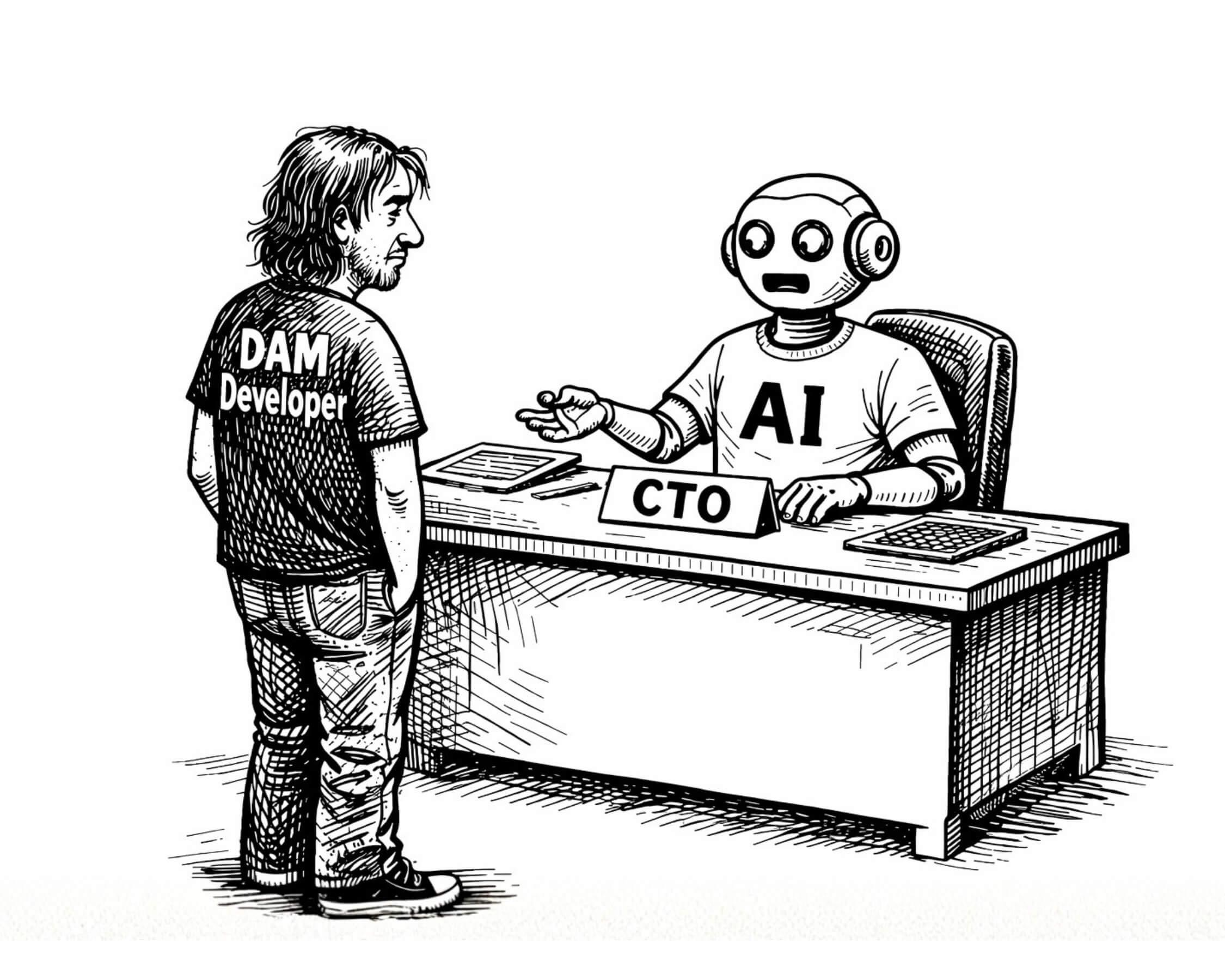
 Where Does AI Leave DAM Developers? Generated Image
So Where Does That Leave DAM?
If AI is creating a euphoric sense of opportunity, its advance will surely expose vulnerabilities in the business models not just of DAM platforms but a myriad of other systems. Sure, AI can help with keywords, it can help with searches and with generating captions and transcripts, but what if it explodes the unique value represented by the human minds of the teams of developers that are behind every single great software system?
There is little reason to doubt the inherent value represented by DAM systems, and their ability to protect, manage and make archives searchable. In a world where AI makes it possible to create photo-realistic images and videos on demand, the value of authentic documentary archives is likely to rise. But what of systems focused on managing templates and the stock imagery used to populate them? If AI can create templates and images in seconds, will companies need to store stock photography to place in pre-designed templates?
A Revolution Without a Roadmap
We are at the beginning of a revolution, the exact outcomes and impact of which are as yet unclear. What is clear, however, is that for all the advantages AI can deliver, it will bring transformative change that could challenge or even invalidate a wide range of established business models and services, much in the way desktop publishing replaced the role of typesetters. With the silver lining, there may well be a not-inconsiderable cloud.
Written by Yvan Cohen | Yvan is a Co-Founder of LightRocket and has spent the past two decades immersed in the challenges and realities of digital asset management. As a professional photojournalist, Yvan uses his decades of media experience to help shape LightRocket's world-class DAM platform; focusing on collaboration, intuitive workflows and continuous innovation.